Sunday, March 1, 2015

Schinus terebinthifolius.Brazilian pepper tree

Schinus terebinthifolius
Brazilian pepper tree
Faux poivrier à baies roses

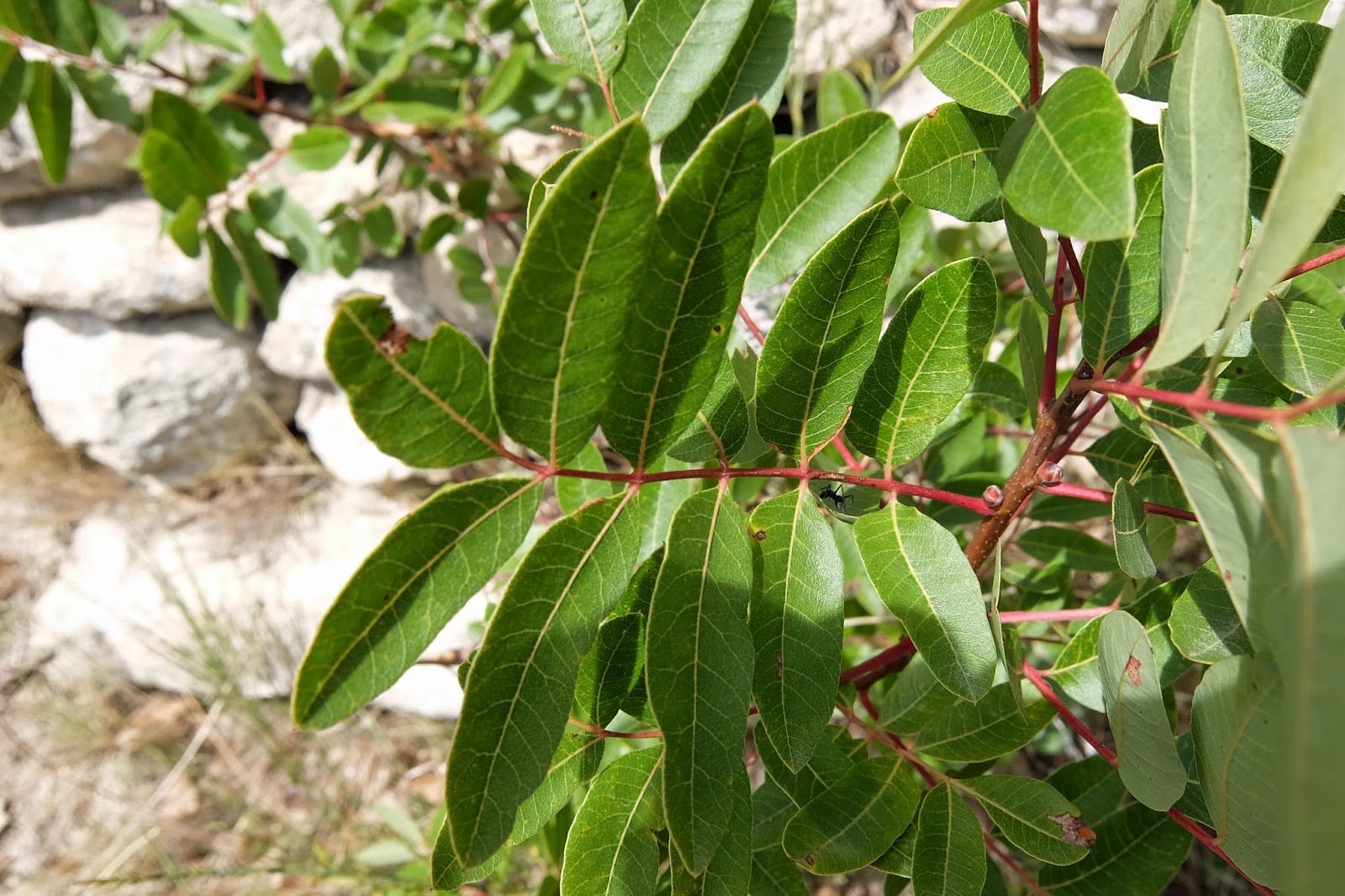
Small, bushy evergreen tree or large shrub, native to South America but widely grown as an ornamental. It typically grows multi-stemmed trunks. It has naturalized and become invasive in the southern US, southern Europe, north Africa, southern Asia and Australia. The plant spreads easily by root suckers to form dense thickets.  S. terebinthifolius resembles Pistacia lentiscus which is native to the Mediterranean, but P. lentiscus is paripinnate, having compound leaves with no terminal leaflet. 

S. terebinthifolius is pinnately compound with 5 - 15 leaflets, with a terminal leaflet. They are oval lanceolate to elliptical, with finely toothed margins and yellowish veins. The leaf rachis is usually slightly winged but not always.
The fruit is a small spherical red drupe carried in dense clusters of berries. Dried drupes are often sold as pink peppercorns although it is not a true pepper.
Shrub form growing alongside a path above Lacoste, 9.22.14

Compound Leaf with terminal leaflet, 9.22.14
Berries, 9.22.14
More berries

Compound leaf with yellow-veined leaflets


Sunday, February 22, 2015

Ruscus aculeatus. Butcher's broom

Ruscus aculeatus
Butcher's broom, Knee holly
Fragon

Rhizomatous, evergreen, subshrub, native to central and southern Europe, West Asia, and North Africa. Grows slowly to  2' - 3' high and wide, preferring shade to deep shade. The common name 'butcher's broom' refers to the tradition of European butchers binding the stiff twigs together and using the bundle to clean their cutting boards. "Aculeatus" means prickly or spiney.

What appear to be leaves are actually modified stem structures called cladophylls. They are ovate, thick, spiney-tipped, and twisted at the base. The flowers are six-petaled, star shaped greenish, white blossoms emerging from the middle of the cladophyll Jan. through April, followed by bright red berries. 
Butcher's broom has been used as a medicinal agent for a variety of purposes, particularly for circulatory problems. The root was used as a substitute for asparagus. 
Ruscus aculeatus should not be confused with cytisus scoparius (broom) or spartium junceum (spanish broom).

Form, along a path in Lacoste, 9.22.14

In the woods by a stone wall in Lacoste, 9.22.14
Stem showing cladophylls or leaf-like structures with their twisted bases, 9.22.14
 
Blossom in center of cladophyll


Berry

Berries on plants in Lacoste woods, 10.7.14

Illustration by Dr. Otto Wilhelm Thomé, 1885

Tuesday, February 10, 2015

Phalaris arundinacea. Reed canarygrass

Phalaris arundinacea. Reed canarygrass
Reed canarygrass
Alpiste faux roseau

The name comes from the Greek 'phalaros', meaning 'brilliant', referring to its silver and shining spikelets. The term 'arundinacea' is from the Latin 'arundinaceus', referring to its resemblance to the reeds.
The range extends over the entire northern hemisphere, Europe, Asia, N. Africa, and N. America. It is common to most of France, growing along stream banks or wetland areas. It can be an invasive species, inhibiting native vegetation and reducing biologic diversity.
Reed canarygrass can reach 7 feet high, with panicles up to 12" long. It is a perennial grass that spreads underground by thick rhizomes as well as by seed. It blooms from May to June with flowers forming on the elongated branched, panicles.


In Situ, early summer
Along a stream below Lacoste, in Provence in the fall


Flowers
In a field
Seed heads in the fall, 9.27.14

Thursday, February 5, 2015

Ceratostigma plumbaginoides.Leadwort

Ceratostigma plumbaginoides
Leadwort
Cératostigma

A flowering herbaceous plant or subshrub, it is native to East Africa and Asia. It is widely used in french gardens and unknown when it was first introduced.
The name is derived from the Greek 'keras' meaning horn and 'stigma' referring to the shape of the stigma.
It flowers at the end of summer, from August through October. The blue flowers are compact, each with a 5-lobed corolla. The leaves are small, oval, lined with curved hairs, and turn red in the fall.

Cascading down the steps of a garden in Lacoste, 9.16.14

Blossoms, 9.16.14

Fall color starting, Lacoste, 9.14.16

Leaf, 9.16.14

Hieracium umbellatum.Narrow Hawkweed

Hieracium umbellatum
Narrow Hawkweed
Épervière de Savoie

Native to Europe and Asia. 
The name is derived from the Greek 'hierakion' and the ancient Greek word 'hierax' for hawk. 'Umbellatum' means like umbels or umbrella-like flower heads. The Roman naturalist, Pliny, believed that hawks fed on this plant to strengthen their eyesight, thus the common name, hawkweed.
Hawkweeds are a large group with 10,000 recorded species and subspecies.
H. umbellatum have yellow ray flowers in long-stalked, loose branched clusters from July to Sept. or Oct. The stems are very leafy with fairly narrow leaves and are covered with fine, stiff hairs. 
The leaves are lanceolate-linear with a tapering tip and base, bristle hairs on the underside, and an entire or sparsely toothed margin.


Bloom


Budding
Form in bloom

In situ in fall, Lacoste, 9.16.14
In Situ, seed heads, 9.16.14

Leaves, 9.16.14
Illustration, Dr. Otto Wilhelm. 1885


Sunday, February 1, 2015

Sedum sediforme.Stonecrop Sedum

Sedum sediforme.Stonecrop Sedum
L'Orpin de Nice

Native to Europe and the Mediterranean region.
Thermophilic - heat loving - species growing on very dry, rocky, calcareous soils.
It grows as mats of erect reddish stems with blue-green fleshy sessile leaves which are glaucous and hairless. The inflorescence is a panicle of yellow flowers June through August.

Leaf Detail

Near the castle ruins at Saint Saturnin-lès-Apt, Luberon,9.16.14 


<


Illustration by PJ Redouté; published in Plantarum Historia Succlentarum, 1799 - 1837

Before flowering
Flower detail

Helianthus x laetiflorus.Hybrid Sunflower

Helianthus x laetiflorus
Hybrid Sunflower
Hélianthe vivace

Hybridized plant of 2 species, H. pauciflorus and H. tuberosus, which are native to North America and have naturalized in Europe. All Helianthus are native to North America.
The leaves are alternate, ovate lanceolate, and serrate.
Blossom August through October.
Blossom, edge of a vineyard, Lacoste, 9.27.14

Edge of a vineyard looking toward le Lubéron range,
Lacoste, 9.27.14


Leaf arrangement, 9.27.14